No products in the cart.: $0.00

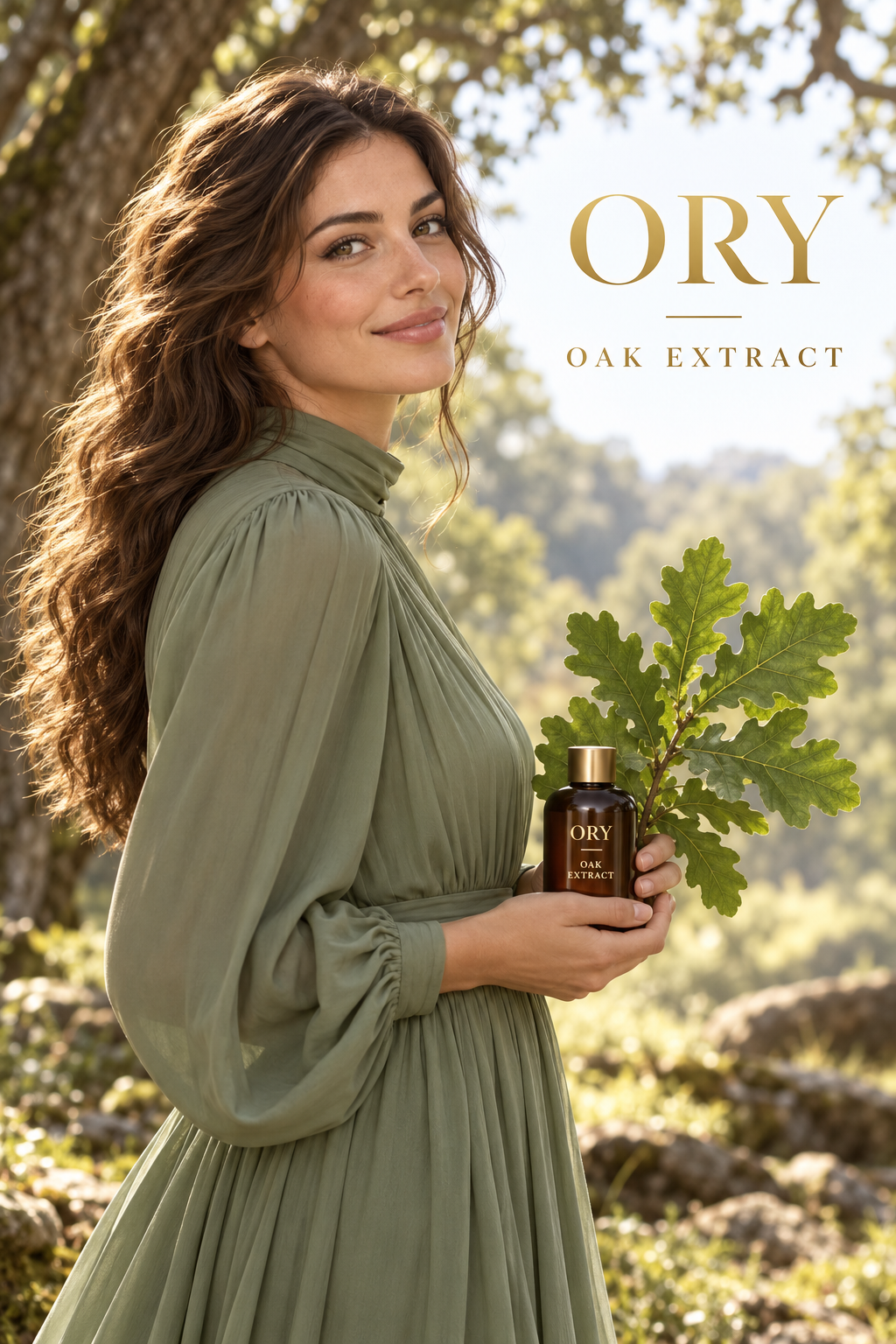
Oak Extract
ORY® product lines:
☑ Skincare
☑ Haircare
☑ Handmade Soap
☑ Cosmetics (limited: color, oil-control primers) — full dual-use ingredient
Oak extract comes from the bark (and sometimes wood or galls) of Quercus species — English oak, white oak, and sessile oak. It is one of the most tannin-rich botanicals in cosmetics: ellagitannins such as castalagin and vescalagin, gallotannins, and the flavonoids quercetin and catechin give it strong astringent, antioxidant, and antimicrobial properties [1, 2]. Oak bark holds a German Commission E monograph for topical use on inflamed skin and excessive sweating, and its tannins precipitate surface proteins to tighten tissue, reduce oozing, and limit microbial growth. In modern formulas oak extract tones oily skin, refines pores, calms irritated scalps, controls scalp oil and odor, and — because tannins are stable at high pH — contributes to handmade soap. Its astringency also makes it drying for already-dry skin, so ORY® uses it in targeted oil-control and toning products.
What is Oak Extract made of?
Oak bark extract is prepared by water, glycerin, or hydro-alcoholic extraction of dried bark; oak galls yield a gallotannin-rich variant. Constituents [1, 2]:
- Ellagitannins (castalagin, vescalagin, grandinin) and gallotannins: Astringent, antimicrobial, antioxidant; the dominant fraction (10–20% of bark).
- Proanthocyanidins (condensed tannins) and catechins: Antioxidant, capillary-protective.
- Flavonoids (quercetin, kaempferol): Anti-inflammatory.
- Ellagic and gallic acids: Free phenolic acids released from tannins; antioxidant, mildly tyrosinase-inhibiting.
- Triterpenes (friedelin, β-sitosterol): Anti-inflammatory minor components.
What skin type is best suited for Oak Extract?
Oak extract is a specialist for oily, congested, and weeping/irritated skin:
- Oily: The primary use — astringent tannins reduce surface oil and shine.
- Acne-prone: Antimicrobial and pore-tightening; supports drying of blemishes.
- Combination: T-zone toners.
- Normal: Occasional toning.
- Sensitive: Low levels can calm weeping irritation (Commission E use), but tannins may tighten; patch test.
- Mature: Antioxidant support; use sparingly because of astringency.
- Dry: Generally avoid; choose oat or calendula instead.
What hair type is best suited for Oak Extract?
Oak bark is a traditional European scalp tonic for oily, sweaty, and irritated scalps:
- Oily scalp: Astringent, oil- and odor-controlling rinses and shampoos.
- Dandruff-prone scalp: Antimicrobial tannins support flake control; calms irritation.
- Sensitive scalp: Low-level anti-inflammatory rinse for weeping or itchy scalps.
- Straight and wavy: Toning rinses; darkens/deepens brunette tones slightly.
- Curly and coily: Scalp-only; tannins can stiffen fiber — follow with conditioner.
- Color-treated: May deepen dark shades; avoid on blonde.
- Dry or damaged, mature or thinning: Scalp-only at low level.
What are the benefits of Oak Extract?
Oak extract’s benefits follow from its tannin chemistry [1, 2]:
- Astringent and pore-refining: Tannins tighten skin and reduce the look of pores.
- Oil and sweat control: Commission E-recognized topical use for hyperhidrosis; reduces surface oil.
- Antimicrobial: Ellagitannins inhibit bacteria and fungi.
- Anti-inflammatory: Reduces redness and weeping in irritated skin.
- Antioxidant: Very high polyphenol content.
- Capillary support: Proanthocyanidins strengthen capillaries.
- Scalp toning and deodorizing: Controls oily, odorous scalps.
- Soap: Tannins survive saponification; adds astringent positioning and warm brown color.
Dual use across ORY® product lines
Oak tannins are pH-stable, letting the extract serve all four ORY® lines; color and astringency guide placement.
| ORY® line | Dual use? | How it is used | Typical level |
|---|---|---|---|
|
ORY® Skincare |
Yes |
Oil-control toners, clarifying masks, foot and underarm products (sweat/odor), post-shave astringents. |
0.5–3% |
|
ORY® Haircare |
Yes |
Oily-scalp shampoos and tonics, deodorizing rinses. |
0.5–2% |
|
ORY® Handmade Soap |
Yes |
Oak bark powder or extract at trace for brown color and astringent "gardener's/athlete's" bars. |
1–2% extract; 1 tsp powder per lb |
|
ORY® Cosmetics |
Limited |
Mattifying primers; natural brown tint in tinted products. |
0.2–1% |
Pros and cons of Oak Extract
Pros
Cons
- Powerful natural astringent: Strong oil and sweat control.
- Monograph support: German Commission E topical use.
- Antioxidant-dense: High polyphenol content [1].
- pH-stable tannins: Works in soap.
- Sustainable: Forestry by-product.
- Drying: Unsuitable for dry or dehydrated skin.
- Staining: Tannins brown formulas and can stain fabric and light hair.
- Tight feel: High levels feel stiff.
- Limited controlled cosmetic trials: Evidence is pharmacological and traditional.
- Interaction: Tannins can bind proteins and iron; keep away from metal-sensitive actives.
What is the best application of Oak Extract?
Oak extract is a targeted toner and scalp tonic:
- Oil-control toner: AM/PM on oily zones after cleansing.
- Clarifying mask: Weekly with kaolin.
- Foot or underarm product: Daily astringent for sweat and odor.
- Post-shave astringent: Tightens and calms.
- Oily-scalp shampoo/tonic: 2–3 times weekly.
- Soap: Astringent brown bar for oily body skin.
- Cosmetics: Mattifying primer.
Peer-reviewed references
- Taib M, Rezzak Y, Bouyazza L, Lyoussi B. Medicinal uses, phytochemistry, and pharmacological activities of Quercus species. Evidence-Based Complementary and Alternative Medicine. 2020;2020:1920683.
- Şöhretoğlu D, Renda G. The polyphenolic profile of oak (Quercus) species: a phytochemical and pharmacological review. Phytochemistry Reviews. 2020;19:1379–1426.
- Blumenthal M, Busse WR, Goldberg A, et al. (eds). The Complete German Commission E Monographs: Therapeutic Guide to Herbal Medicines. American Botanical Council; 1998. (Oak bark monograph — regulatory source.)
Disclaimer:
The information on this page is provided by ORY International, LC for educational purposes only. It summarizes published research about oak extract as an ingredient, including laboratory and animal studies and clinical studies of formulas that may differ from ORY® products. Results from these studies may not apply to every person or to ORY® products. This page is not medical advice and does not replace advice from a dermatologist, physician, or other qualified healthcare provider.
ORY® Skincare, Haircare, Handmade Soap, and Cosmetics products are cosmetics. They are not intended to diagnose, treat, cure, mitigate, or prevent any disease or condition, including acne, excessive sweating (hyperhidrosis), eczema, infections, wounds, or dandruff. References to FDA or Cosmetic Ingredient Review (CIR) findings describe the ingredient, not ORY® products, and do not mean FDA has reviewed or approved any ORY® product.
Results vary by skin and scalp type, formulation, and use. Oak extract is astringent and can dry or irritate some skin, and any cosmetic can cause irritation, sometimes from other ingredients. Always patch test, follow label directions, and stop use if irritation occurs. If you are pregnant, nursing, have a medical condition, or are buying for a child, consult a healthcare provider before use.
ORY International, LC works to keep this page accurate and current but makes no warranty as to its completeness. To the fullest extent permitted by law, ORY International, LC is not liable for any loss or injury arising from reliance on this information or from use of any product contrary to its label directions. To report a reaction, contact us at [insert contact email / phone].