No products in the cart.: $0.00

Ylang Ylang Essential Oil
ORY® product lines:
☑ Skincare (low-level; balancing)
☑ Haircare (traditional scalp and hair oil)
☑ Handmade Soap (accelerates trace — soap cool)
◐ Cosmetics (perfumery; strict allergen limits) — dual-use with IFRA-restricted constituents
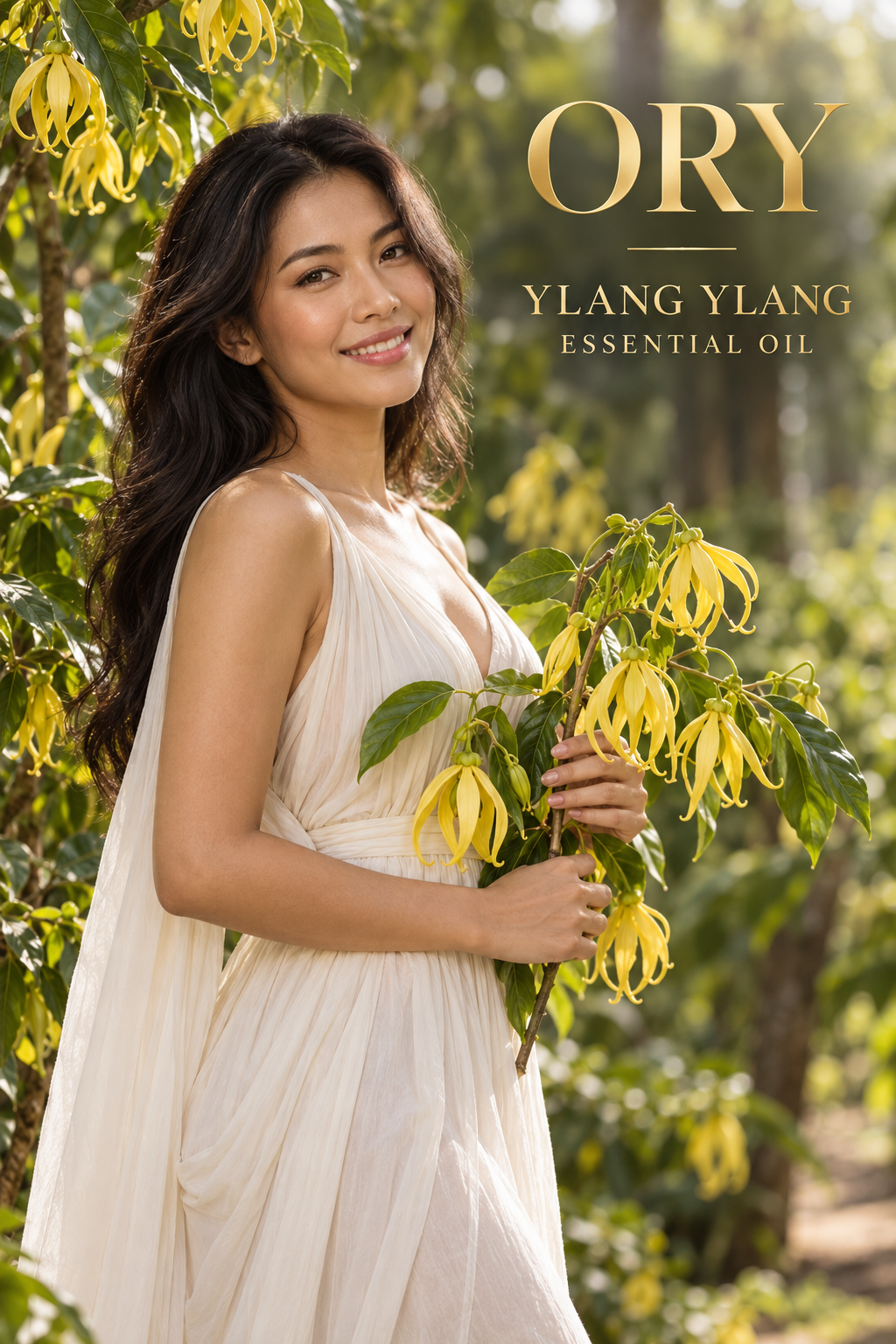
Ylang ylang is the steam-distilled oil of the Cananga odorata flower, cultivated in Madagascar, the Comoros, and Indonesia — one of perfumery’s great florals and, in Southeast Asian tradition, a hair and scalp oil. Pharmacological reviews document its antimicrobial, anti-inflammatory, and sedative activity [1], and transdermal ylang ylang lowered blood pressure and pulse while raising calm in a human study [2]. Its rich ester-and-phenol chemistry is also its limitation: it contains several labeled allergens, including IFRA-restricted isoeugenol, which cap leave-on use at roughly 0.8% [3, 4]. ORY® uses it at low levels for sebum-balancing skin oils, traditional hair and scalp oils, and soap — where it is a beloved but trace-accelerating floral.
What is Ylang Ylang Essential Oil made of?
Ylang ylang is fractionally steam-distilled from fresh flowers; the first fraction (Extra) is the most floral, later fractions (I–III) heavier; “Complete” is the whole distillate. Composition [1, 4]:
- Linalool (10–20%), geranyl acetate, benzyl acetate, benzyl benzoate (5–15%), benzyl salicylate: Floral esters and alcohols; several labeled allergens.
- Germacrene D, β-caryophyllene, farnesene (higher in later grades): Sesquiterpenes; anti-inflammatory.
- p-Cresyl methyl ether, isoeugenol (0.5–1%), eugenol: Phenolic notes; isoeugenol is IFRA-restricted (sensitizer).
- Dermal maximum: ~0.8% leave-on (Tisserand/IFRA, isoeugenol-based); rinse-off up to ~2%; soap 1–3% [3, 4].
What skin type is best suited for Ylang Ylang Essential Oil?
Ylang ylang suits oily, combination, and normal skin at low levels:
- Oily: Traditional sebum-balancing oil; 0.3–0.5%.
- Combination: Balancing and calming.
- Normal: Luxurious floral body oils.
- Acne-prone: Antimicrobial at low levels [1].
- Mature: Body oils; relaxing evening ritual [2].
- Dry: In rich body oils at 0.3%.
- Sensitive: ≤0.2% or avoid; multiple allergens — patch test.
What hair type is best suited for Ylang Ylang Essential Oil?
Ylang ylang is a traditional hair and scalp oil:
- Oily scalp: Traditional sebum balancer; 0.5% in scalp oils.
- Dandruff-prone scalp: Antimicrobial support in shampoos and scalp oils.
- Dry or damaged: Aromatic addition to hair oils (lengths and ends).
- Straight, wavy, curly, coily: Fragrance and scalp-comfort addition at low levels.
- Color-treated: Low-level use; avoid the first 48 hours after coloring.
- Sensitive scalp: Lowest end of the range; patch test.
- Mature or thinning: Scalp-massage blends with rosemary and lavender.
What are the benefits of Ylang Ylang Essential Oil?
Ylang ylang’s benefits are supported by review and human evidence [1, 2]:
- Antimicrobial: Activity against skin bacteria and fungi [1].
- Anti-inflammatory: Sesquiterpenes reduce inflammation [1].
- Relaxation: Lowered blood pressure and pulse, increased calm after transdermal absorption [2].
- Sebum balance: Traditional for oily skin and scalp.
- Hair conditioning tradition: Southeast Asian hair oils for shine and scalp.
- Luxury floral fragrance: Perfumery heart note.
- Soap: Rich floral scent; blends with lavender, bergamot, sandalwood.
Dual use across ORY® product lines
Ylang ylang serves skin, hair, and soap at low levels; cosmetics use is limited by allergen restrictions.
| ORY® line | Dual use? | How it is used | Typical level |
|---|---|---|---|
|
ORY® Skincare |
Yes |
Balancing face and body oils, evening massage oils, bath oils (solubilized). |
0.2–0.5% face; 0.5–0.8% body |
|
ORY® Haircare |
Yes |
Scalp and hair oils, shampoos and conditioners for oily scalps. |
0.5–1% rinse-off; ≤0.5% leave-in |
|
ORY® Handmade Soap |
Yes |
Floral bars; accelerates trace — soap cool, add at light trace, use grade III or Complete. |
1–3% of oil weight |
|
ORY® Cosmetics |
Limited |
Solid perfumes and scented balms at low levels; allergen labeling. |
0.1–0.3% |
Pros and cons of Ylang Ylang Essential Oil
Pros
Cons
- Human relaxation evidence: [2].
- Antimicrobial, balancing: [1].
- Luxury floral: High appeal.
- Hair-oil tradition: Scalp and shine.
- Soap-usable: With care.
- Multiple allergens incl. isoeugenol: ≤0.8% leave-on [3, 4].
- Accelerates trace: Soap technique required.
- Heady scent: Can cause headache/nausea at high levels.
- Grade variability: Specify grade.
- Cost (Extra grade): Premium.
What is the best application of Ylang Ylang Essential Oil?
Ylang ylang is diluted into balancing and relaxing products:
- Balancing face oil: 0.3% with jojoba.
- Evening massage oil: 0.5–0.8% in sweet almond [2].
- Scalp oil: 0.5% with rosemary in jojoba.
- Shampoo: 0.5–1%.
- Soap: 1–3% (grade III), cool soaping.
- Solid perfume: 0.3%.
Peer-reviewed references
- Tan LTH, Lee LH, Yin WF, et al. Traditional uses, phytochemistry, and bioactivities of Cananga odorata (ylang-ylang). Evidence-Based Complementary and Alternative Medicine. 2015;2015:896314.
- Hongratanaworakit T, Buchbauer G. Relaxing effect of ylang ylang oil on humans after transdermal absorption. Phytotherapy Research. 2006;20(9):758–763.
- International Fragrance Association. IFRA Standards, 51st Amendment. IFRA; 2023. (Regulatory fragrance-safety limits.)
- Tisserand R, Young R. Essential Oil Safety: A Guide for Health Care Professionals. 2nd ed. Churchill Livingstone/Elsevier; 2014. (Dermal-limit reference.)
Disclaimer:
The information on this page is provided by ORY International, LC for educational purposes only. It summarizes published research about ylang ylang essential oil as an ingredient, including laboratory and animal studies and clinical studies of formulas that may differ from ORY® products. Results from these studies may not apply to every person or to ORY® products. This page is not medical advice and does not replace advice from a dermatologist, physician, or other qualified healthcare provider.
ORY® Skincare, Haircare, Handmade Soap, and Cosmetics products are cosmetics. They are not intended to diagnose, treat, cure, mitigate, or prevent any disease or condition, including eczema, acne, dandruff, infections, wounds, pain, headache, anxiety, insomnia, hair loss, or any other condition. References to FDA or Cosmetic Ingredient Review (CIR) findings describe the ingredient, not ORY® products, and do not mean FDA has reviewed or approved any ORY® product.
Results vary by skin and scalp type, formulation, and use. Ylang ylang oil contains isoeugenol and other fragrance allergens; its strong scent can cause headache at high levels. Any cosmetic can cause irritation, sometimes from other ingredients. Always patch test, follow label directions, and stop use if irritation occurs. If you are pregnant, nursing, have a medical condition, or are buying for a child, consult a healthcare provider before use.
ORY International, LC works to keep this page accurate and current but makes no warranty as to its completeness. To the fullest extent permitted by law, ORY International, LC is not liable for any loss or injury arising from reliance on this information or from use of any product contrary to its label directions. To report a reaction, contact us at [insert contact email / phone].