No products in the cart.: $0.00

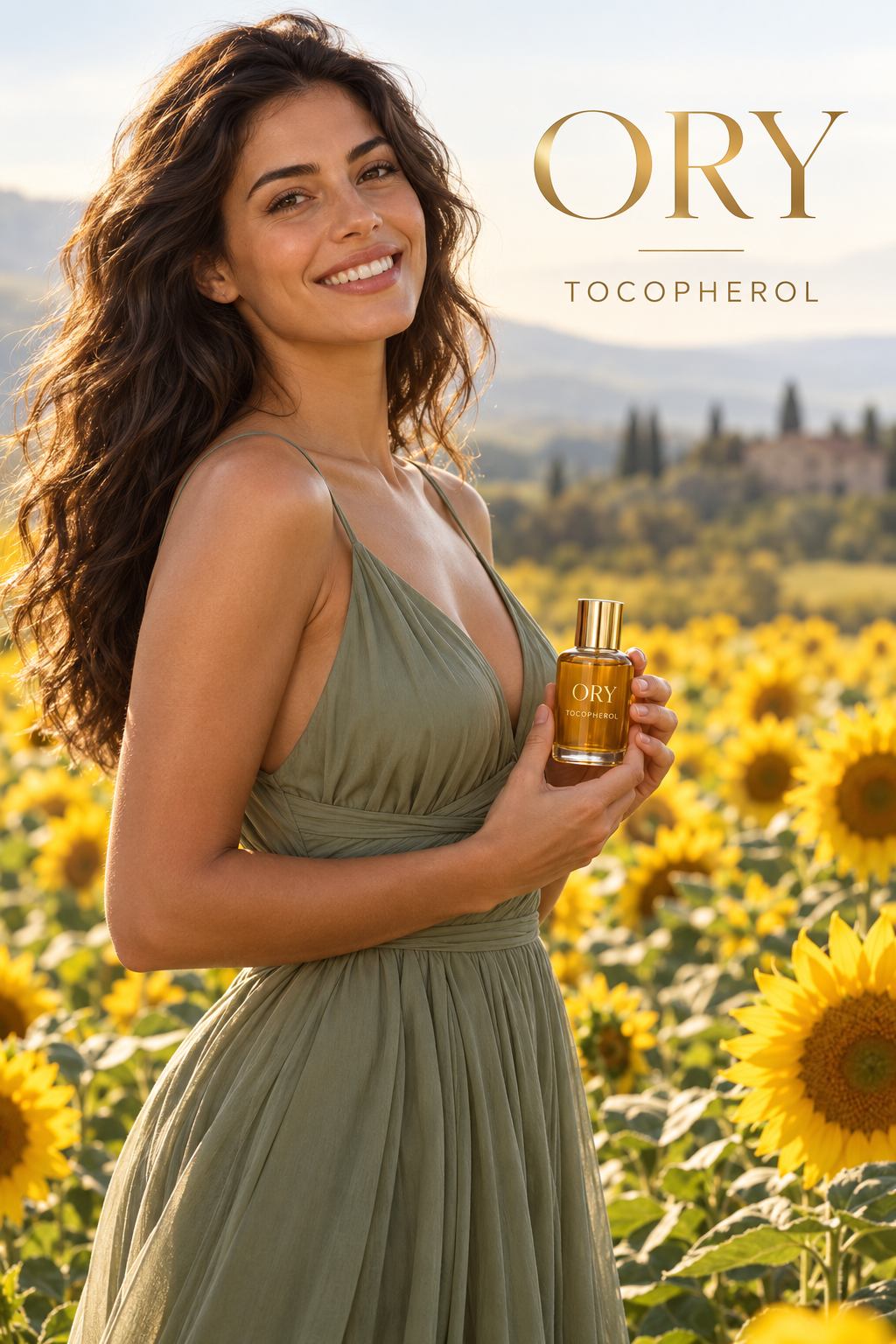
Tocopherol
ORY® product lines:
☑ Skincare
☑ Haircare
☑ Handmade Soap (the antioxidant that prevents rancidity and orange spots)
☑ Cosmetics — full dual-use ingredient (see also the Vitamin E (Tocopheryl Acetate) document)
Tocopherol is free vitamin E — the active, unesterified form — and it does two different jobs for ORY®. On skin it is the body’s principal lipid-phase antioxidant, concentrated in sebum and the stratum corneum, where it stops the chain reactions of lipid peroxidation triggered by UV and pollution [1]; reviews document its antioxidant, photoprotective, moisturizing, and anti-inflammatory roles [2]. In the bottle it is the formulator’s antioxidant: unlike tocopheryl acetate, free tocopherol actively sacrifices itself to protect unsaturated oils, butters, and soap from rancidity — the “dreaded orange spots” of cold-process bars and the paint-like smell of oxidized oils [3]. Mixed tocopherols (rich in gamma and delta) are more effective formula antioxidants than alpha alone. The Cosmetic Ingredient Review Panel has concluded tocopherols are safe in cosmetics [4]. Two honest caveats carry over from the acetate document: neat, high-level vitamin E can cause contact dermatitis, and a controlled study found no benefit for scars [5], so ORY® uses tocopherol at 0.1–1% and makes no scar claims.
What is Tocopherol made of?
Tocopherol is extracted from vegetable-oil deodorizer distillates (soybean, sunflower, rapeseed) by molecular distillation; d-alpha may be concentrated or the natural mix retained. Points to know [1, 3, 4]:
- Alpha-tocopherol: Highest biological vitamin activity in skin.
- Gamma- and delta-tocopherol: Strongest formula antioxidants — best for protecting oils and soap [3].
- Mixed tocopherols (typically 50–95% total tocopherols in oil): ORY®‘s working grade; viscous amber oil; oil-soluble; light-sensitive.
- Free vs. acetate: Free tocopherol is an active antioxidant in formulas and on skin immediately; the acetate is stable but inert until skin esterases convert it.
- Typical use: 0.1–0.5% as formula antioxidant (0.5–1% for polyunsaturated oils); 0.5–2% as skin active; 0.5–1% in soap oils.
- Non-GMO, sunflower-derived grades available; kosher/vegan.
What skin type is best suited for Tocopherol?
Tocopherol suits all seven ORY® skin types at gentle levels:
- Mature: Photoprotective antioxidant; protects collagen and lipids [1, 2].
- Dry: Emollient; supports barrier lipids [2].
- Normal: Daily antioxidant maintenance.
- Combination: Light levels in serums.
- Sensitive: Anti-inflammatory at low levels; high or neat vitamin E can cause dermatitis [5] — keep ≤1%, patch test.
- Oily: 0.2–0.5% in light emulsions and oils.
- Acne-prone: Low levels; moderately comedogenic at high concentration.
What hair type is best suited for Tocopherol?
Tocopherol protects hair lipids, scalp, and the oils in every hair product:
- Color-treated: Antioxidant protection against oxidative fading.
- Dry or damaged: Protects cuticle lipids; keeps hair oils fresh.
- Mature or thinning: Antioxidant scalp support (cosmetic claims).
- Sensitive scalp: Anti-inflammatory support at low levels.
- Straight, wavy, curly, coily: Antioxidant in all hair oils and serums.
- Oily and dandruff-prone scalp: Low-level antioxidant.
What are the benefits of Tocopherol?
Tocopherol’s benefits are supported by reviews, safety assessment, and lipid-oxidation science [1–5]:
- Skin antioxidant: Stops lipid peroxidation in the stratum corneum [1].
- Photoprotection (adjunct): Reduces UV-induced damage; synergistic with vitamin C and ferulic acid [2].
- Moisturizing and anti-inflammatory: Supports the barrier; calms UV redness [2].
- Formula antioxidant: Protects oils, butters, balms, and soap from rancidity — extends shelf life [3].
- Soap protection: Prevents orange spots and off-odors in cold-process bars.
- Hair lipid and color protection: Guards against oxidation.
- Regenerates vitamin C: Antioxidant network with ascorbic acid [2].
- Natural, non-GMO options: Sunflower-derived.
Dual use across ORY® product lines
Tocopherol is a true four-line ingredient — the antioxidant in every ORY® oil-containing product, and the one that protects soap.
| ORY® line | Dual use? | How it is used | Typical level |
|---|---|---|---|
|
ORY® Skincare |
Yes |
Facial and body oils, serums, creams, balms, sunscreens, C-E-ferulic serums; antioxidant in all oil phases. |
0.1–1% antioxidant; 0.5–2% active |
|
ORY® Haircare |
Yes |
Hair oils, serums, scalp oils, conditioners, color-protect products. |
0.1–1% |
|
ORY® Handmade Soap |
Yes |
Added to the recipe oils before lye to prevent rancidity/orange spots; also protects infused oils and superfats. |
0.5–1% of oil weight |
|
ORY® Cosmetics |
Yes |
Lipsticks and balms, foundations, powders, cream products (antioxidant and emollient). |
0.1–1% |
Pros and cons of Tocopherol
Pros
Cons
- Dual role: Skin active and formula antioxidant.
- Protects soap and oils: Essential for shelf life [3].
- Skin’s own antioxidant: Biocompatible [1].
- CIR-reviewed safe: [4].
- Natural, non-GMO: Sunflower grades.
- Light- and heat-sensitive: Less stable than the acetate; store dark; add at cool-down for maximum activity.
- Contact dermatitis at high levels: Keep ≤1–2% [5].
- No scar benefit: Controlled study found none; make no scar claims [5].
- Color and odor: Amber tint; faint odor at high levels.
- Sacrificial: Depletes as it protects; dose by oil polyunsaturation.
What is the best application of Tocopherol?
Tocopherol is added to every oil-containing product and used as a skin active:
- Formula antioxidant: 0.1–0.5% mixed tocopherols in oils, balms, and creams; 0.5–1% for grapeseed, hemp, rosehip, borage.
- Soap: 0.5–1% of oil weight stirred into the oils before adding lye.
- Antioxidant serum: 1% d-alpha-tocopherol with 15% vitamin C and 0.5% ferulic acid.
- Face or body oil: 0.5–1% as active plus antioxidant.
- Hair oil: 0.5%.
- Lip balm: 0.5–1%.
- Cosmetics: 0.2–0.5% in lipsticks and creams.
Peer-reviewed references
- Thiele JJ, Ekanayake-Mudiyanselage S. Vitamin E in human skin: organ-specific physiology and considerations for its use in dermatological practice. Molecular Aspects of Medicine. 2007;28(5–6):646–667.
- Keen MA, Hassan I. Vitamin E in dermatology. Indian Dermatology Online Journal. 2016;7(4):311–315.
- Kamal-Eldin A, Appelqvist LÅ. The chemistry and antioxidant properties of tocopherols and tocotrienols. Lipids. 1996;31(7):671–701.
- Fiume MM, Bergfeld WF, Belsito DV, et al. Safety assessment of tocopherols and tocotrienols as used in cosmetics. International Journal of Toxicology. 2018;37(2 Suppl):61S–94S.
- Baumann LS, Spencer J. The effects of topical vitamin E on the cosmetic appearance of scars. Dermatologic Surgery. 1999;25(4):311–315.
Disclaimer:
The information on this page is provided by ORY International, LC for educational purposes only. It summarizes published research about tocopherol (vitamin E) as an ingredient, including laboratory and animal studies and clinical studies of formulas that may differ from ORY® products. Results from these studies may not apply to every person or to ORY® products. This page is not medical advice and does not replace advice from a dermatologist, physician, or other qualified healthcare provider.
ORY® Skincare, Haircare, Handmade Soap, and Cosmetics products are cosmetics. They are not intended to diagnose, treat, cure, mitigate, or prevent any disease or condition, including eczema, dermatitis, acne, dandruff, or any other condition. References to FDA or Cosmetic Ingredient Review (CIR) findings describe the ingredient, not ORY® products, and do not mean FDA has reviewed or approved any ORY® product.
Results vary by skin and scalp type, formulation, and use. Vitamin E can cause allergic contact dermatitis, especially at high concentrations. Any cosmetic can cause irritation, sometimes from other ingredients. Always patch test, follow label directions, and stop use if irritation occurs. If you are pregnant, nursing, have a medical condition, or are buying for a child, consult a healthcare provider before use.
ORY International, LC works to keep this page accurate and current but makes no warranty as to its completeness. To the fullest extent permitted by law, ORY International, LC is not liable for any loss or injury arising from reliance on this information or from use of any product contrary to its label directions. To report a reaction, contact us at [insert contact email / phone].